
The Importance Recognizing and Interpreting Poetry in Scripture

Perhaps it is on my mind because of Poetry Month, but as I read the Psalms and Isaiah especially this week, it stands out to me that a lack of recognizing poetry leads to all sorts of misinterpretations. For example, I read this morning in Psalm 46:6, “the earth melts.” The same word is used in:
Exodus 15:15
[15] Now are the chiefs of Edom dismayed;
trembling seizes the leaders of Moab;
all the inhabitants of Canaan have melted away.
And in:
Joshua 2:9
[9] and said to the men, “I know that the LORD has given you the land, and that the fear of you has fallen upon us, and that all the inhabitants of the land melt away before you.
Joshua 2:24
[24] And they said to Joshua, “Truly the LORD has given all the land into our hands. And also, all the inhabitants of the land melt away because of us.”
Such makes a difference when you read other places in the Bible that are misconstrued as a literal passing away of the earth. For example:
2 Peter 3:11-13
[11] Since all these things are thus to be dissolved, what sort of people ought you to be in lives of holiness and godliness, [12] waiting for and hastening the coming of the day of God, because of which the heavens will be set on fire and dissolved, and the heavenly bodies will melt as they burn! [13] But according to his promise we are waiting for new heavens and a new earth in which righteousness dwells.
Psalm 46 further informs us of the City of God. Ash writes,
“This is the first occurrence in the Psalms of the expression city of God. Psalm 48:1 identifies it with the “holy mountain,” that is, Mount Zion (cf. 2:6; 15:1; 24:3). This city is holy, utterly distinct from the sinful chaos of the surrounding world, set apart for God. It can be occupied only by those covered by the righteousness of Christ.”
And this informs us of how to read what Isaiah says in Isaiah 60 about the same city. As Eric Alexander points out in his sermon Isaiah 60, this is not about the reestablishment of Israel in 1947, but about the church.
Furthermore, Alec Motyer takes Isaiah 60 and makes this statement:
“As so often in Isaiah, the shape of this poem is its message.”
And then he goes into setting forth a detailed schematic of the poem in a chiastic pattern to prove it.
The description of the church is clear in Isaiah 60, as sure as the apostle applied it to the Christians in Ephesus (Cf. Eph. 5:14). He was not talking about the nation of Israel, but the body of Christ. Moreover, the City of God, if you will, that “holy, utterly distinct from the chaos of the surrounding world, set apart for God” people (Ash) is described roughly in Isaiah 60 as: associated with glory (1–5), accepted (6–7), attractive (8–9), diverse (10–11), dangerous (12 Center of poem), vindicated (13–14), joyful (15–16), transformed (17–18b), growing more beautiful by the day (18c–22).1
But the point is mainly this: the shape of the poem is the message, and what lays central in the poem are the nations serving and submitting to the church in the world and thus being blessed or cursed. They are like Song of Songs describes, dangerous like a mare among Pharaoh’s chariots!
See how poetry permeates Scripture! To ignore poetry throughout the Bible or to interpret everything that is a poem literally is simply absurd. Moreover, it leads to all sorts of implications for how the world is viewed.
For example, as war rages in the East, a big part of it is how some Christians have misinterpreted poetry to result in calling the physical battles on earth holy war. This runs contrary to real holy war that is described in poetic terms of Isaiah 59:17, and its corresponding text of Ephesians 6:10ff. See what trouble the world is given because poetry is not recognized in Scripture as it is — poetry. When such is on the mind in study, one will be able to compare Scripture with Scripture to draw the lines between what is figurative and what is a straight forward statement.
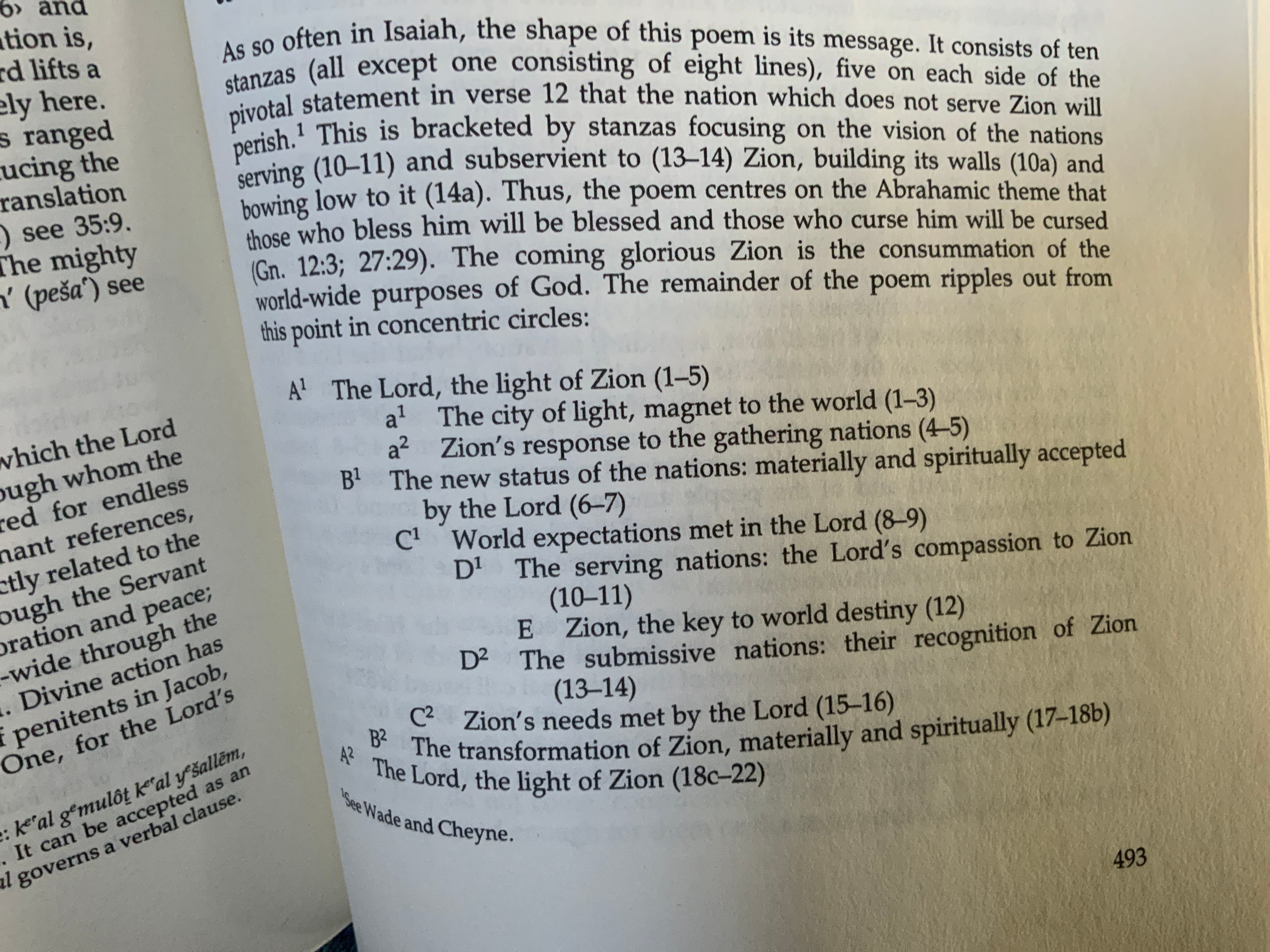
This list are my roughly sketched notes of observation on the description of the church in that chapter.